Building Sacred Spaces Where Communities Gather, Worship, & Grow
Metal Church Buildings: A Complete Guide for Congregations, Contractors & Architects
Key Takeaways
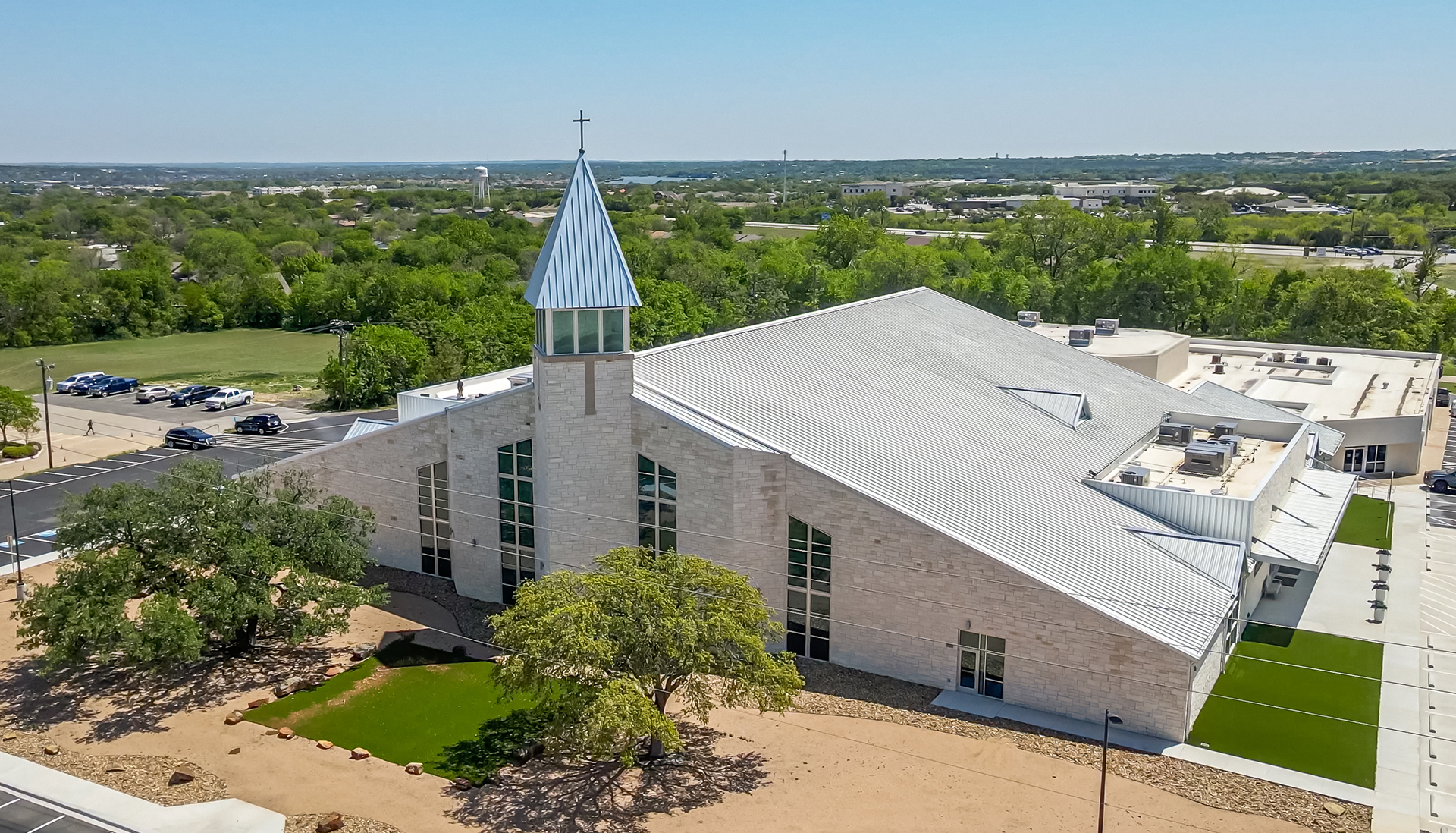
Metal church buildings are pre-engineered (PEMB) steel structures, prefabricated off-site and erected on yours, designed around how a congregation worships, gathers, and learns. Wide clear spans keep worship space free of sightline-blocking columns, faster erection protects the ministry calendar, and brick, stone, and stained-glass finishes keep a traditional look. Coastal Steel Structures supports general contractors, architects, and church owners with materials, erection, or full furnish & erect, and delivered the 33,950 sq ft Granbury Church of Christ on schedule and inside its budget.
Last updated
Project proof: Granbury Church of Christ
33,950 sq ftworship, education, offices, and eventsin one building, Granbury, TX
On scheduleopened when the congregation plannedwith a custom open steeple
Inside budgetfinal cost within the set budgetfunded entirely by the congregation
A church building isn’t just a structure. It’s the place a community returns to, week after week, for generations. That means it has to be right: right acoustics, right sightlines, and right flexibility for how the congregation actually uses it. We’ve delivered prefab metal church buildings and houses of worship across the country, and we know the difference between a building that meets specs and one that serves people.
Rooted in South Florida and building in nearly every region of the country, Coastal Steel Structures works with general contractors, architects, and church building committees to make sure the steel side of a church project never becomes the problem.
Why Do Churches Choose Prefab Metal Buildings?
Short answer: Budget accountability. Church projects are funded by the congregation, so there’s no corporate cushion for cost overruns, and delays have real consequences for a ministry calendar. Prefabricated, pre-engineered steel delivers faster erection, more budget certainty, and the wide clear spans that sanctuaries and fellowship halls require.
Church projects carry weight that most commercial builds don’t: budget accountability to a congregation, not a corporate client; design intent that reflects values, not just function; and timeline pressure tied to ministry calendars, not just contract milestones. Pre-engineered metal buildings are built for that reality.
Column-free worship space: Wide clear spans eliminate the interior columns that break sightlines, which matters most for fan-shaped and arena-style seating that wraps around the platform.
Budget certainty: The building is engineered and specified before fabrication, so the committee knows what it is committing to and there are fewer on-site variables to push the project off budget.
Faster erection: Components are prefabricated off-site and erected on yours, which keeps the project on schedule and shortens the disruption to the campus around it.
A floor plan that follows the ministry: Open clear-span interiors leave room for walls and partitions to be rearranged, so a church can try a new ministry, or retire one, without wasting square footage. In a small church, where one family moving away can end a ministry, that flexibility protects every square foot.
Low maintenance: Steel doesn’t rot, warp, or attract pests. Routine inspections of fasteners, seals, and roof panels are typically all that’s needed, so the congregation’s resources stay in the ministry, not the facility.
Noncombustible framing: Steel framing won’t burn, resists mold, and gives termites nothing to eat.
It’s not the easy choice. It’s the responsible one.
Prefab Steel vs. Traditional Church Construction
How a pre-engineered metal building compares with conventional wood or masonry construction on the factors church projects weigh most.
Factor
Prefab steel (PEMB)
Conventional wood or masonry
Budget
Engineered and specified before fabrication, with fewer on-site variables
More work happens on site, where weather and site conditions can move the final number
Schedule
Fabricated off-site, then erected quickly to protect ministry calendar dates
Longer on-site build that is more exposed to weather delays
Worship space
Wide clear spans with no interior columns breaking sightlines
Long open spans typically call for interior columns or heavier specialty framing
Maintenance
Won’t rot, warp, or attract pests; routine checks of fasteners, seals, and roof panels
Wood framing can rot, warp, and attract termites over time
Fire and moisture
Noncombustible framing that resists mold
Wood framing is combustible and can hold moisture
Appearance
Brick, stone, stucco, EIFS, wood siding, and stained glass over a steel frame
The same traditional finishes
Want to know how the frame, secondary members, and panels fit together? See our guide to the anatomy of a steel building.
Worship, Fellowship, and Education Spaces: What Each One Needs
Most church campuses combine several kinds of space under one roof or across a connected campus. Granbury Church of Christ, for example, supports worship, education, administration, and community events in a single 33,950 sq ft building. Each space puts different demands on the structure.
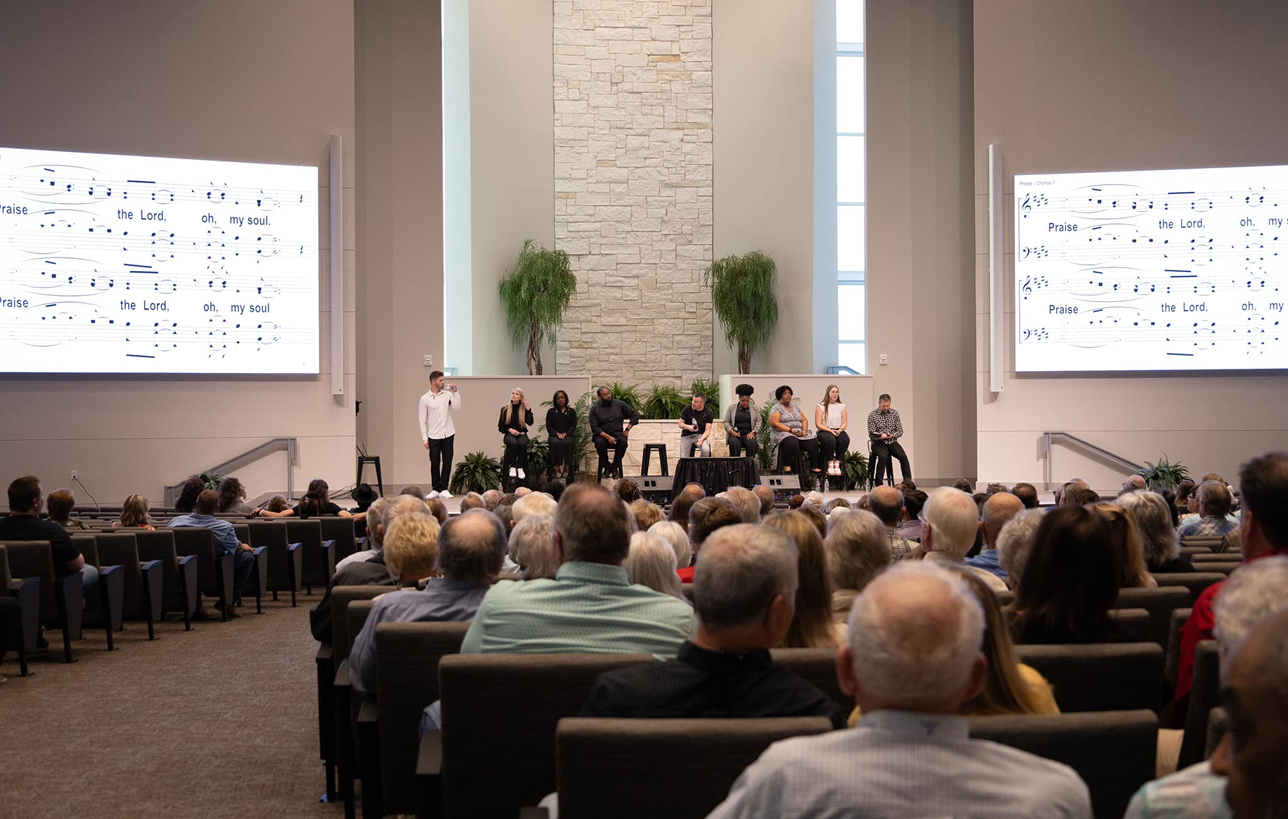
Sanctuaries and Worship Spaces
Short answer: Sanctuaries need clear spans wide enough to eliminate columns that break sightlines, ceiling heights that support acoustics, and structural provisions for elements like open steeples or decorative facades.
Plan for
Column-free sightlines to the platform
Ceiling heights that support acoustics
Fan-shaped or arena-style seating
Open steeples and decorative facades
Where the building gets out of the way
Worship spaces have structural demands that standard specs don’t always account for. We’ve engineered and delivered sanctuaries with those details already figured out, so the building your congregation walks into reflects the vision behind it, not the compromises that were made to get it built.
Fellowship Halls and Multi-Use Spaces
Short answer: Fellowship halls work harder than almost any space in a church facility, so they need the right clear spans, layout flexibility, and structural provisions to support every use without requiring a different building for each one.
One space, every gathering
Worship services
Community events
Youth programs
Meals
Meetings
Designed around how you gather
A building that works for one use but not the others isn’t really built for the congregation. We design multi-use spaces around how your community actually functions.
Classrooms and Education Wings
Short answer: Education wings need smaller individual spaces, sufficient ceiling heights, layout logic that keeps foot traffic organized, and structural systems that support expansion as the ministry grows.
Plan for
Smaller individual rooms
Sufficient ceiling heights
Organized foot traffic
Room to expand
Built for learning, sized to grow
We work through those details early, so the building you open on day one is the building your ministry needs, and one that can be expanded without starting over.
Nurseries, Dining Halls, Recreation Centers, and Offices
Supporting spaces are often where a church campus grows next. Each one can share a steel building with worship and education or sit in its own connected wing.
Space
What it supports
What to plan for
Nursery and preschool
Childcare and early education
Smaller individual rooms and layout logic that keeps foot traffic organized
Dining hall
Meals, receptions, and community events
Clear spans and layout flexibility so the room can also serve fellowship uses
Recreation center
Youth programs, recreation, and community outreach
Wide clear spans for open, column-free activity space
Meeting halls
Small groups, committee meetings, and classes
Layouts that can be rearranged as ministries change
Offices and administration
Church staff and ministry planning
Smaller individual spaces that can share a building with worship and education
Can a Prefab Metal Church Look Like a Traditional Church?
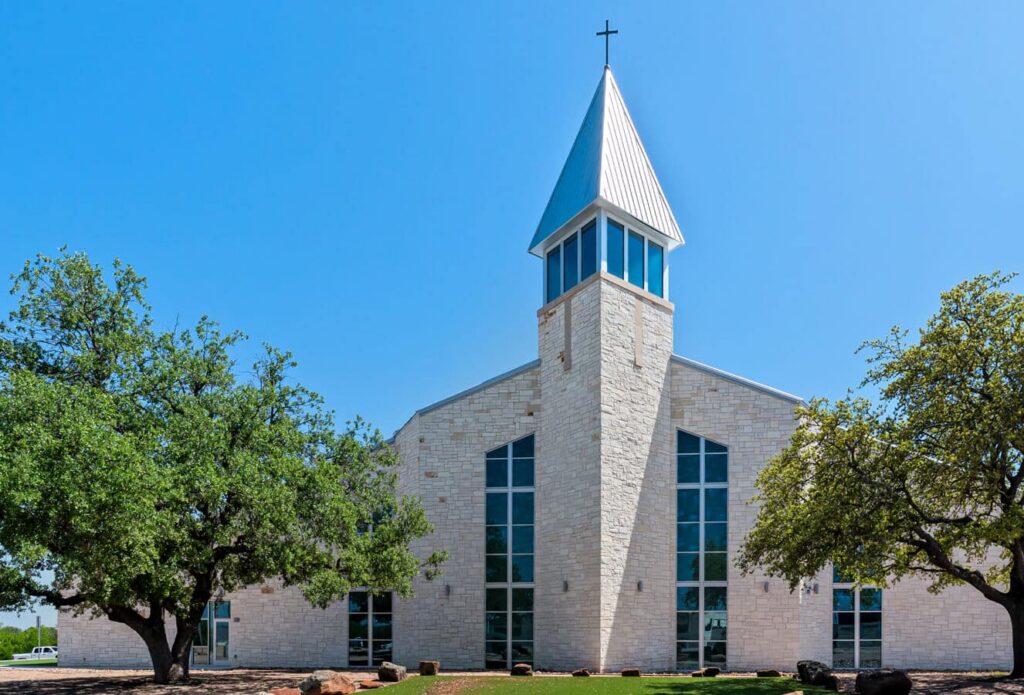
Short answer: Yes. A pre-engineered steel frame can be finished in brick, stone, masonry, stucco, EIFS, or wood siding, with stained-glass windows, traditional rooflines, and covered entryways, so the building looks like the house of worship your congregation expects.
Exterior finishes
Brick and masonry
Natural or cultured stone
Stucco and EIFS
Wood siding
Stained-glass windows
Architectural features
Traditional or modern rooflines
Covered entryways
Custom windows and doors
Open steeples
Decorative facades and parapets
Open steeples, decorative structural elements, and facade materials that differ from the primary structure all add complexity. They need engineering attention that not every supplier is equipped to provide, so we work through that complexity before steel ships, not on the job site.
At Granbury Church of Christ, that meant a custom-engineered expansion joint in the steeple framing, so the open steeple could flex with temperature changes and wind loads without cracking the finish materials around it.
How Does a Church Plan a Metal Building Project?
Short answer: Bring your general contractor in early, define every way the building will be used, review every option before committing, lock design features before steel ships, plan campus connections early, and build to the ministry calendar.
The sequence
Bring your general contractor in early. Most church projects run through a GC, and the earlier the GC brings us in, the more we can do: preliminary pricing tiers, lead time realities, and building configurations that hold up through design. No GC yet? We can start with your committee and partner with the contractor you choose.
Map every use. List worship, fellowship, education, administration, and community uses, plus the ministries you expect to grow, so spans and layouts are sized for all of them.
Review every option before committing. Lay out value engineering options with full visibility into what each tradeoff gives up, so the committee keeps real authority over the budget.
Lock design features before steel ships. Resolve steeples, facades, and finish materials during design, and sequence the facade trades before anyone mobilizes.
Plan campus connections early. Match elevations, exterior transitions, mechanical systems, and structural compatibility during design, and sequence work so your existing facility stays open.
Build to the ministry calendar. Faster erection keeps the project on schedule, so opening day lands where the congregation expects it.
For General Contractors: How We Support Church Projects
Short answer: Coastal Steel Structures fits around the way your job is set up: materials only, erection only, or full furnish & erect, with one team accountable for the steel side of the church project while you run the job.
Most of our religious work comes through general contractors. Church jobs add pressure that a standard commercial bid doesn’t carry: a congregation watching every dollar, a steeple or facade that can’t be value-engineered away, and an existing campus that has to stay open. We take the steel side of that off your plate.
Materials only
You have the crew. We multi-quote the pre-engineered metal building through our manufacturing network, with options tiered by price, lead time, and spec, so you choose what wins the bid.
Erection only
You have the steel. We source a dependable erector from our vetted roster, align on scope and schedule before boots hit the ground, and stay involved while the building goes up.
Furnish & erect
We handle both. One call, one team, one point of accountability for materials and erection, so the handoff between them never becomes your problem.
What that means on a church job
Steeples and facades solved in preconstruction: Open steeples, parapets, and mixed finish materials are engineered and sequenced before steel ships, not discovered on site.
Campus tie-ins planned early: Elevations, exterior transitions, and mechanical coordination with existing buildings are resolved during design.
Options the building committee can approve: Value engineering choices are laid out with full visibility into each tradeoff, which keeps owner approvals moving.
A project manager who stays in it: Your Coastal project manager stays engaged through delivery and erection, keeping issues off your plate.
For general contractors
Materials, labor, or both, sourced around what’s driving your job.
Granbury Church of Christ had outgrown its previous facility and needed one building for worship, education, administration, and community events. The I-beam structural system delivered open, column-free worship and assembly space, a custom-engineered expansion joint preserved the open steeple, and EIFS, cultured stone, and mechanical features were coordinated across multiple trades during design rather than during erection. The new building connected to an existing structure while that facility stayed in use, opened on schedule, and landed inside the budget the congregation set.
A prefab or PEMB (pre-engineered metal building) church is a church whose steel frames, secondary members, and panels are engineered for the project, fabricated off-site, and bolted together on site. It goes up faster than conventional construction and can be finished to look like a traditional church.
What types of religious buildings do you deliver?
Sanctuaries, fellowship halls, classrooms, education wings, and multi-use facilities, across denominations and building types. Religious projects vary widely in what they require, and we’ve delivered enough of them to know where the complexity lives.
Why do church building committees choose steel over traditional construction?
Budget accountability. Church projects are funded by the congregation, so there’s no corporate cushion for cost overruns, and pre-engineered steel delivers faster erection, more budget certainty, and the wide clear spans that sanctuaries and fellowship halls require.
Can a metal church building look like a traditional church?
Yes. A pre-engineered steel frame can be finished in brick, stone, masonry, stucco, EIFS, or wood siding, with stained-glass windows, traditional rooflines, and covered entryways.
Can PEMB structures support design elements like steeples or decorative facades?
Yes, but they require engineering attention that not every supplier is equipped to provide. Open steeples, decorative structural elements, and facade materials that differ from the primary structure all add complexity, and we work through it before steel ships, not on the job site.
Can a metal church building be expanded later?
Yes. Pre-engineered steel buildings can be designed with future growth in mind, so a worship space or education wing can be expanded as the ministry grows without starting over.
Can you integrate a new building with an existing campus structure?
Yes. Campus additions and building connections introduce specific requirements (mechanical systems, exterior finish continuity, and structural compatibility) that have to be resolved early, and we’ve managed those integrations successfully.
Can our congregation keep using the existing church during construction?
Yes, with planning. At Granbury Church of Christ, construction was sequenced so the existing facility stayed operational while the new building went up beside it.
Can you supply materials only or erection only for a church project?
Yes. General contractors can bring us in for materials only, erection only, or full furnish & erect, and we fit around the crew and schedule already on the job.
Do you work with general contractors, architects, or directly with church building committees?
All three. Most of our religious work comes through general contractors and architects, but we work directly with church owners and building committees as well, with honest lead times, flexible material and labor options, and a team that stays engaged from the first conversation to the final bolt.
Your Congregation Deserves a Building Built to Last
Whether you’re a contractor bidding a church project, an architect finalizing a design, or a building committee in early planning, we’re a straightforward conversation. Tell us what you’re building and we’ll show you what we can do.