

Most sports complex problems start in planning, not on the job site. Start a PEMB sports building at 24 feet of clear height (high school and club volleyball call for 23 feet; the NCAA requires 25 feet in facilities built after 2006), size the clear span to your court count, and plan parking for tournament days. Coastal Steel Structures designs and erects I-Beam sports buildings with clear spans reaching 300 feet, with steel typically shipped in 5 to 8 weeks.
PEMB sports complex at a glance
- 24 ftclear heightRecommended starting point
- 300 ftI-Beam clear spanNo interior columns
- 5 to 8 wkssteel fabricated and shippedErection in 2 to 3 weeks
Sports complexes don't usually go wrong on the job site. They go wrong months earlier, in the planning phase, when a ceiling height isn't right for the program, a parking lot isn't sized for the events the operator wants to host, or an interior column lands somewhere that compromises court layout for the next twenty years.
We've delivered indoor sports complexes, gymnasiums, fitness centers, and recreation facilities across the country. The buildings that perform are the ones where the planning decisions were made with the operation in mind, not against a generic floor plan. This guide walks through what to resolve before you break ground, and when each decision becomes permanent.
Why a PEMB Fits a Sports Complex
Indoor sports complexes have a specific structural problem to solve: wide, uninterrupted spans. A column in the middle of a basketball court isn't a design preference. It's the difference between a court that can host real play and one that can't. A pre-engineered metal building (PEMB) handles that requirement better than any other building system on the market.
Clear span, no interior columns
Rigid frames carry the roof from sidewall to sidewall, so the full floor stays open for courts, fields, and sightlines. Nucor Building Systems, one of our authorized manufacturers, publishes I-Beam clear spans in excess of 300 feet.
A schedule you can plan around
Components are engineered and fabricated off-site. Steel is typically manufactured and shipped in 5 to 8 weeks while the foundation goes in, which matters when your opening date is tied to a season or a lease.
Room to grow
A prefab steel frame can be extended with new bays later, as long as the expansion is planned into the original design.
How a pre-engineered sports building goes together
- Primary frames: rigid steel columns and rafters that carry loads from the roof to the foundation and make column-free spans possible.
- Secondary members: purlins (roof) and girts (walls) that connect to the frames and support the panels.
- Roof and wall panels: the building envelope, with insulation specified for comfort, code, and acoustics.
See the full anatomy of a steel building
Clear span vs. modular: a clear-span building has no interior columns, so the full width is open. A modular building places interior columns across the width, which saves steel but rarely works for court and field layouts.
Metal buildings are a mainstream choice, not a niche one: the U.S. Department of Energy reported in 2014 that metal buildings consistently make up more than 40 percent of new low-rise nonresidential construction. According to the Metal Building Manufacturers Association (MBMA), metal buildings are made from recycled steel and are 100 percent recyclable at the end of their service life. Nucor Building Systems offers PVDF paint warranties up to 35 years and 20-year weathertightness warranties.
The Decision Timeline: When Each Choice Becomes Permanent
Every planning decision has a point after which changing it gets expensive or impossible. Use this table to see what has to be settled, and when.
| Decision | Lock it in by | Why it's hard to change later | Who to involve |
|---|---|---|---|
| Site and zoning | Before you buy or lease the land | Zoning decides whether the use is allowed, plus setbacks and height limits | Local building department |
| Operating plan | Before design starts | Ceiling height, span, floor system, and support spaces all follow from the program | Owner and operator |
| Parking and site use | Before the site plan is final | The lot has to handle tournaments and league nights, not average days | Site designer, building department |
| Accessibility | Before the court layout is final | An accessible route has to reach each court, which affects court spacing | Architect, Coastal Steel |
| Clear height | Before steel is manufactured | Eave height is engineered into the frames | Coastal Steel |
| Clear span and layout | Before steel is manufactured | Column-free width is set by the frame design | Coastal Steel |
| Expansion capacity | Before steel is manufactured | Endwalls and structure have to be designed to take additions | Coastal Steel |
| Fire sprinklers | Before the building size is final | Crossing 12,000 sq ft in one fire area can trigger sprinklers under the IBC | Code official, fire protection engineer |
| Insulation and acoustics | Before the panel package is ordered | The envelope controls comfort, condensation, and noise | Coastal Steel, mechanical engineer |
| Floor system | Before slab and finish budgets are set | Turf, hardwood, rubber, and foam each need different planning and finishes | Owner, architect |
What to Resolve Before the Steel Is Manufactured
The cost surprises and design regrets on a sports complex almost always trace back to decisions that weren't fully worked through during planning. Here's where to spend the time upfront.
Zoning and Permitting
Zoning is where the project starts, not where it gets handled later. Local zoning determines whether the building is even allowed on the site you're considering, what setbacks apply, how high the structure can go, and what use categories you're permitted to operate. A site that looks perfect on paper can be the wrong site once the zoning conversation happens.
Visit your local building department before you commit to the property. They'll walk you through the permitting requirements specific to a sports or recreation facility in your jurisdiction and flag anything that needs to be resolved before a design moves forward.
Parking and Site Use
Parking for a sports complex has to account for tournaments, league nights, and the high-attendance events that fill the schedule and pay the lease, not just a normal weekday. Underbuild here and you're turning customers away on your best revenue days.
Those event days are a real market. Sports ETA counted 204.9 million sports travelers in 2023 for amateur and youth events and collegiate tournaments, with $52.2 billion in direct spending, including $4.7 billion on tournament operations.
The parking lot is also part of the operational footprint. Outdoor courts, overflow programming, food service, and event space can all extend from the building into the lot. Plan it as part of the facility, not as an afterthought.
Ceiling Height and Clear Span
Ceiling height is one of the few decisions that's almost impossible to fix later. For most indoor sports, 24 feet of clear height is the right starting point. Some uses can work at 20 feet, but taller is almost always better, and lighting and HVAC are easier to fit when there's room to run them above the play area.
Overhead clearance by governing body
| Sport and governing body | Overhead clearance | Status |
|---|---|---|
| Volleyball, NFHS (high school) | At least 23 ft | Recommended |
| Volleyball, USA Volleyball | 23 ft | Required for nationally sanctioned competition |
| Volleyball, NCAA | 25 ft (41 ft recommended) | Required for facilities built after 2006 |
| Tennis, ITF | 29.6 ft at the net | Recommended minimum for covered courts |
Sources: 2024 NCAA, NFHS and USAV volleyball rules comparison (NFHS); ITF 2026 Rules of Tennis, Appendix X. A 24-foot building clears high school and club volleyball; plan for 25 feet or more if collegiate play is part of the program, and more for indoor tennis.
Clear span is the other side of the same coin. The wider the column-free span, the more layout flexibility the building gives you. Multi-court configurations, court changes as your program evolves, and unobstructed sightlines for spectators and members all depend on getting the span right at the design stage. Use the court fit calculator below to test widths.
Accessibility and Life Safety
Accessibility shapes the layout, not just the restrooms. Under the 2010 ADA Standards, as summarized by the U.S. Access Board:
- Courts and play areas: an accessible route has to connect each court and each area of sport activity (sections 206.2.12 and 206.2.13).
- Team and player seating: wheelchair spaces are required based on seating capacity, with at least one (section 221.2.1.4).
- Exercise equipment: at least one of each type of machine needs a 30 x 48 inch clear floor space on an accessible route (section 236).
- Locker rooms: at least 5 percent of lockers, and no fewer than one of each type, must be accessible (section 225.2.1).
- Bowling: at least 5 percent of lanes, and no fewer than one of each type, must be accessible (section 206.2.11).
Fire protection, emergency exits, and occupancy limits are set by your local code. See code, fire, and wind requirements below.
Insulation, Acoustics, and Condensation
Insulation is a permit requirement in most jurisdictions, but the reasons to take it seriously go beyond code. Insulation also works as acoustic treatment, which matters when the building hosts league nights, tournaments, or programming that runs late. A facility that's too loud, inside or outside, becomes a problem with neighbors and the surrounding community.
It also controls condensation. A steel building with too little insulation, or an HVAC system that isn't designed for the space, can collect condensation, especially in climates with big temperature swings. For sports complexes, a heavy-duty vinyl or PVC-faced insulation is worth specifying upfront for durability: better performance, longer service life, and a day-one experience that reflects what members are paying for.
The Operating Plan
The building has to support the business, not the other way around. Before any design work happens, get clear on who your customers are, what activities the facility will support, and how the program will change over the next five to ten years. A facility built for turf sports has different requirements than one built for court sports, and a multi-use complex has to handle both without compromising either.
Floor systems
Hardwood, rubber, felt, turf, and foam each serve different sports. Choose the floor with the program, not after it.
Support spaces
Locker rooms, warm-up and training areas, restrooms, concessions, retail, first aid, and viewing areas all compete for the same footprint. Plan them alongside the courts.
Revenue beyond play
Rentals, tournaments, private events, parties, and food service can all live in a clear-span building if the layout plans for them.
Program changes
Courts, turf, and event floors get reconfigured as membership grows. Open floor makes that a schedule change instead of a renovation.
Long-Term Flexibility
Sports complexes grow. A facility that opens with four courts often needs six within a few years, and a single-program gym frequently becomes a multi-program operation as membership grows. The structural capacity for expansion is much cheaper to build in at the start than to retrofit later. Endwalls can be designed to take future bays, so the building can be extended without major work on the existing structure.
We ask about future plans upfront. Designing for flexibility almost always costs less than working around its absence five years later.
How Many Courts Fit in a PEMB Sports Building?
Short answer: a 100x200 clear-span building fits 6 pickleball courts at USA Pickleball's recommended 34 x 64 ft playing surface, or 9 at the 30 x 60 ft minimum. A 100x300 fits 8 recommended pickleball courts, 8 NFHS volleyball courts, or 5 high school basketball courts.
Maximum courts by building size
| Building (ft) | Pickleball, recommended 34x64 | Pickleball, minimum 30x60 | Volleyball, NFHS 30x60 + 6 ft | Basketball, NFHS 84x50 + 3 ft | Tennis, ITF club play |
|---|---|---|---|---|---|
| 80x150 (12,000 sq ft) | 4 | 5 | 3 | 1 | 1 |
| 100x100 (10,000 sq ft) | 2 | 3 | 2 | 1 | 0 |
| 100x200 (20,000 sq ft) | 6 | 9 | 4 | 3 | 1 |
| 100x300 (30,000 sq ft) | 8 | 15 | 8 | 5 | 2 |
| 121x242 (The Pickleball Club) | 9 | 16 | 6 | 4 | 4 |
Maximum courts per building in a simple grid, clear span, before spectator seating, circulation, and support spaces. Each court uses its full playing area: USA Pickleball 2026 Rule 3.A (30 x 60 ft minimum, 34 x 64 ft recommended); NFHS volleyball (30 x 60 ft court plus 6 ft clearance); NFHS basketball (84 x 50 ft plus 3 ft of unobstructed space); ITF Appendix X club play (36 x 78 ft plus 18 ft behind baselines and 10 ft beside sidelines). Adjacent courts that share runoff can fit more; confirm the final layout with your design team.
Planning estimates only. The calculator checks court footprints and clear height; seating, circulation, support spaces, and local code shape the final building. Widths above 300 feet are outside the I-Beam clear spans we cite on this page.
Sports Facility Types and What Drives Each Building
A prefab metal building gives you a clean slate for a range of fitness and leisure uses. Here's what drives the building design for the most common ones.
| Facility | What drives the building | Reference point |
|---|---|---|
| Indoor pickleball | Wide clear span for multiple courts, sightlines, lighting, and acoustics | The Pickleball Club: 121 ft wide, 26 ft eave, no interior columns |
| Basketball and volleyball | Clear height above the play area and runoff around each court | 23 ft (NFHS, USAV); 25 ft (NCAA, built after 2006) |
| Indoor tennis | Long runoff behind baselines and the tallest clearance of the court sports | ITF: 29.6 ft at the net for covered courts |
| Indoor turf and fields | Span and length for field dimensions | Common footprints: 100x100 (10,000 sq ft), 100x200 (20,000 sq ft), 100x300 (30,000 sq ft) |
| Trampoline parks | Open floor for courts and foam pits, plus party and guest space | About half the floor for trampolines; see below |
| Indoor skydiving | Housing high-horsepower fans and wind tunnels | Custom structure engineered around the tunnel |
| Competition and training arenas | Clear span for speed and runs, eave height, spectator viewing | Wellington International: 205x420x24, 86,100 sq ft |
| Bowling | Long, open floor | ADA: 5 percent of lanes accessible, at least one of each type |
Other uses we build for
- Fitness and training centers
- Martial arts and dance studios
- Natatoriums
- Climbing and ropes courses
- Laser tag and arcades
- Party and meeting space
- On-site dining
- Community space for partner clubs
Indoor Pickleball Facilities
Short answer: plan each court on a 34 x 64 ft playing surface (USA Pickleball's recommendation for new construction), which fits 6 courts in a 100x200 clear-span building. Demand is there: 24.3 million Americans played pickleball in 2025, up 22.8 percent in one year.
By the numbers
- 24.3 million US players in 2025, up 171.8 percent over three years (SFIA)
- 20 x 44 ft court; 30 x 60 ft minimum playing surface; 50 x 80 ft stadium court (USA Pickleball)
Planning notes
- Clear span: columns between courts cost you courts. Check widths with the calculator.
- Acoustics: paddle noise carries. Insulation and wall panels double as sound control.
- Proof: see The Pickleball Club, our clear-span pickleball stadium in Port St. Lucie.
Trampoline Parks
Short answer: plan for about half of a trampoline park's floor to be trampolines, with the rest for check-in, lockers, party rooms, and gathering space. Franchise parks typically fall between 16,000 and 50,000 square feet.
By the numbers
- 378 US trampoline park businesses as of 2024, up 6.2 percent from 2023 (IBISWorld)
- 16,000 to 50,000 sq ft: Sky Zone's three park-size tiers, at an estimated $3.2M to $6.4M total investment (2026 FDD)
- ASTM F2970: the industry standard for trampoline court design, installation, operation, and inspection
Planning notes
- Revenue model: guests pay for jump time, with extra revenue from equipment rental and premium-zone upcharges. The layout should support all three.
- Clear span: a column-free building keeps the most floor open for jumping areas.
- Maintenance: many owners become certified service technicians to handle trampoline upkeep themselves.
Sources: SFIA 2026 Topline Participation Report (2025 data), as reported by Pickleball.com; USA Pickleball 2026 Official Rulebook, Rule 3.A; IBISWorld, Trampoline Parks in the US (2024); Sky Zone 2026 Franchise Disclosure Document; International Association of Trampoline Parks.
Code, Fire, and Wind Requirements to Plan For
Two code questions change the building itself, so they belong in planning, not permitting.
Fire sprinklers and building size
Most indoor sports buildings are assembly occupancies (Group A-3, or A-4 with spectator seating). Under the International Building Code (sections 903.2.1.3 and 903.2.1.4), these need automatic sprinklers when a fire area exceeds 12,000 square feet or holds 300 or more occupants. A 100x100 building is 10,000 sq ft, an 80x150 is exactly 12,000 sq ft, and a 100x200 is 20,000 sq ft, so most multi-court buildings cross the line. Confirm the edition your jurisdiction has adopted with your code official.
Wind design in the Southeast
The 8th Edition (2023) Florida Building Code, effective December 31, 2023, references ASCE 7-22 for wind, flood, and other design loads. Miami-Dade and Broward counties fall in the High-Velocity Hurricane Zone, with stricter requirements still. We built our foundation in Florida, and every frame we deliver is engineered for the wind and load conditions of its site.
Sports and Athletic Facilities We've Built
Every building below is a clear-span PEMB we delivered. Dimensions are width x length x eave height in feet.
| Project | Location | Use | Dimensions | Size |
|---|---|---|---|---|
| Wellington International | Wellington, FL | Covered competition arena | 205x420x24 | 86,100 sq ft |
| 5M Livestock | Oxford, FL | Competitive team roping arena | 140x320 | 44,800 sq ft |
| Speed Williams Roping Arena | Comanche, TX | Training arena and roping academy | 150x200x16 | 30,000 sq ft |
| Howard Covered Riding Arena | Wellington, FL | Covered riding arena | 138x210x20 | 28,980 sq ft |
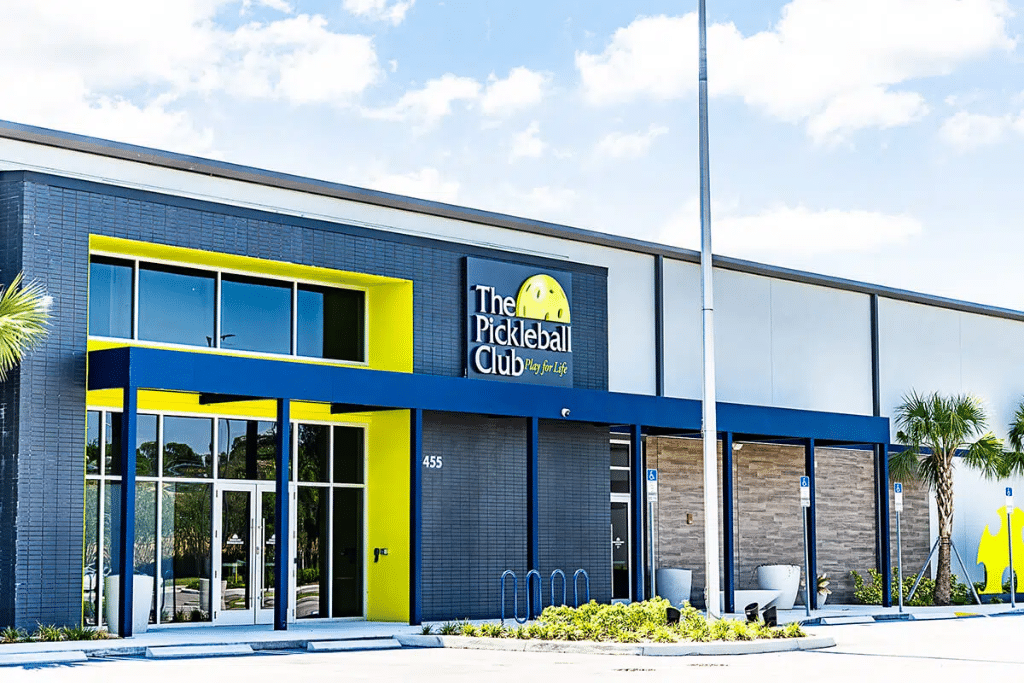
| The Pickleball Club | Port St. Lucie, FL | Indoor pickleball stadium | 121x242x26 | 26,000 sq ft |
| One More Child | Jacksonville, FL | Community center | 100x250x18 | 25,000 sq ft |
| TerraNova Equestrian Center | Myakka City, FL | Covered riding arena | 79x219x18 | 17,301 sq ft |
The Pickleball Club, Port St. Lucie, FL
- Type
- Indoor pickleball stadium
- Dimensions
- 121x242x26
- Size
- 26,000 sq ft
- System
- I-Beam, full clear span
The Pickleball Club needed an indoor facility that worked for open play, lessons, leagues, and competitive matches without the layout compromising any of them. We delivered a clear-span I-Beam building with open courts, clean sightlines, and no columns interrupting play, engineered for Florida's heat, humidity, and storms.
Wellington International, Wellington, FL
- Type
- Covered competition arena
- Dimensions
- 205x420x24
- Size
- 86,100 sq ft
- System
- I-Beam
On Wellington International's 111-acre property, this is the largest equestrian arena ever built for the venue and its partner, and the largest of its kind in South Florida. It lets riders train and compete year-round regardless of weather, with room for the spectators that competition draws.
Common Sports Complex Planning Mistakes
Designing around a generic floor plan
The building should follow the operating plan, not the other way around.
Sizing parking for an average day
Tournaments and league nights are your best revenue days. Plan for them.
Settling for minimum height
Twenty feet works for some uses, but it rules out others you may want later. Start at 24 feet.
Under-specifying insulation
Too little insulation, or HVAC that isn't designed for the space, leads to condensation, noise complaints, and higher operating costs.
Sizing the building before checking sprinklers
Going from 12,000 to 12,500 square feet can add a sprinkler system. Settle the footprint and fire areas together.
Skipping the expansion conversation
Building in capacity for future bays costs far less than retrofitting it.
Budgeting from online price-per-square-foot figures
Most figures published online cover materials only. Door systems, clear span, site conditions, local loads, and interior build-out drive the real number.
How the Process Works, and How Long It Takes
Metal buildings are custom engineered to fit your specific needs. No two are exactly alike.
The sequence
- Define what matters most. We build a list of specifications around your program: clear height, span, insulation, noise-reducing wall panels, and flexible wall configurations.
- Engineer the building. Your specifications go into our design program, which produces a unique blueprint for your facility and site loads.
- Fabricate while the foundation goes in. Steel is typically manufactured and shipped in 5 to 8 weeks while the foundation is built.
- Erect the building. Depending on size and complexity, erection typically takes 2 to 3 weeks.
Single-source responsibility makes a PEMB the most efficient and cost-effective option for a sports and recreation facility.
Building a Sports Complex for a Client?
Most of our sports projects come through general contractors and architects. Here's what we bring to the job.
For general contractors
We supply and erect the building as one scope, with material issues resolved with the manufacturer directly. We are authorized builders for Nucor and Varco Pruden, with regional manufacturers available when the schedule is tight, and we source accredited erectors close to your site in 48 states.
For architects
We work from your design intent, including designs not originally drawn for steel, and translate them into a pre-engineered system without losing what makes them work.
Metal Construction News ranks Coastal Steel Structures 11th in square footage and 14th in tonnage on its Top 100 Metal Building Contractors for 2025, with zero reportable safety incidents five years running.
Frequently Asked Questions
How tall should an indoor sports complex be?
Start at 24 feet of clear height. High school and club volleyball standards call for 23 feet, the NCAA requires 25 feet in facilities built after 2006, and the ITF recommends 29.6 feet at the net for covered tennis courts.
How many pickleball courts fit in a 100x200 metal building?
Six courts fit at USA Pickleball's recommended 34 x 64 foot playing surface, or nine at the 30 x 60 foot minimum, in a simple clear-span grid before seating and circulation.
How wide can a clear-span PEMB sports building be?
Nucor Building Systems, one of our authorized manufacturers, publishes clear spans in excess of 300 feet for I-Beam structures, with no interior support.
How long does it take to build a PEMB sports complex?
Once the design is final, steel is typically manufactured and shipped in 5 to 8 weeks while the foundation is built, and erection typically takes 2 to 3 weeks depending on size and complexity.
How much does it cost to build a sports complex?
There's no reliable price per square foot, and most figures published online cover materials only. Clear span, eave height, door systems, site conditions, local wind and snow loads, sprinklers, and interior build-out drive the real number.
Does an indoor sports facility need fire sprinklers?
Under the International Building Code, Group A-3 and A-4 assembly spaces need automatic sprinklers when a fire area exceeds 12,000 square feet or has an occupant load of 300 or more. Confirm the code edition your jurisdiction has adopted with your code official.
Can a steel sports building be expanded later?
Yes, if expansion is planned into the original design. Endwalls and structure can be engineered to take future bays, which costs far less than retrofitting.
How big is a trampoline park building?
Sky Zone's 2026 franchise tiers run from 16,000 to 50,000 square feet, and about half of a trampoline park's floor is typically used for trampolines.
What should I check before buying land for a sports complex?
Visit the local building department first. Zoning decides whether the use is allowed on the site, along with setbacks, height limits, and permitted use categories.
What causes condensation in a metal sports building?
Condensation usually comes from too little insulation or an HVAC system that isn't designed for the space, especially in climates with big temperature swings. Specifying both properly upfront prevents it.
Plan Your PEMB Sports Complex With Us
Tell us what you want to run in the building, and we'll engineer the structure around it.