

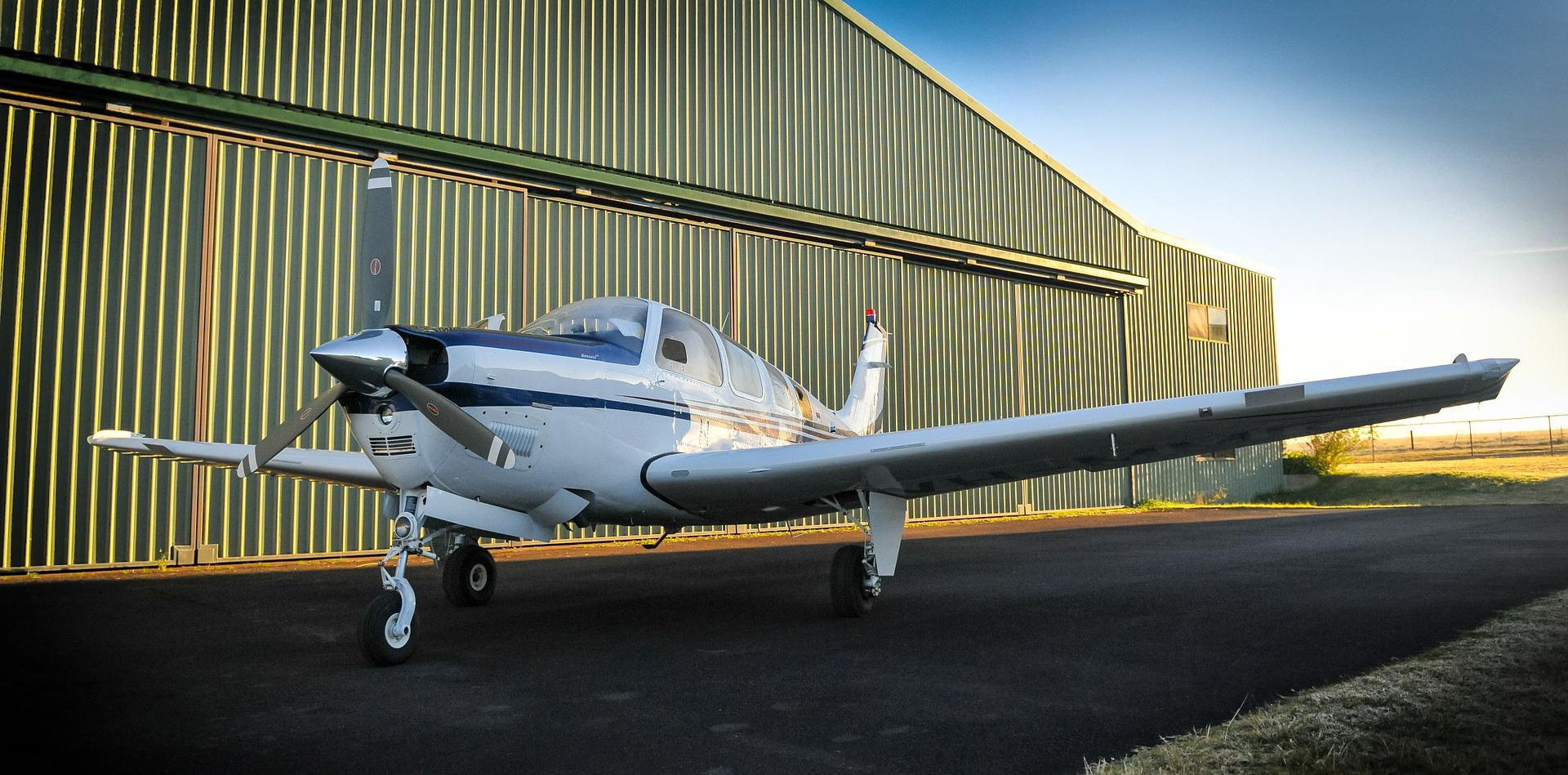
An airplane hangar is a clear-span building sized around the aircraft inside it. There’s no reliable per square foot price: cost is driven by the door system, clear span, site conditions, local wind, snow, and seismic loads, and whether you build on private land or an airport leasehold. A single piston aircraft fits in under 3,000 sq ft; corporate and multi-aircraft hangars commonly run 10,000 to 50,000 sq ft. Permitting and door lead time set most schedules, and NFPA 409 sets fire protection. Coastal Steel Structures engineers each hangar around the aircraft and the operation going into it.
Hangars at a glance
- Under 3,000sq ftSingle piston aircraft
- 10,000 to 50,000sq ftCorporate and multi-aircraft
- Weeks vs. monthsto buildPrivate single vs. commercial or FBO
An airplane hangar is one of the more demanding building types you can take on. Door openings have to clear the aircraft. Clear spans have to perform without interruption. Drawings have to match what gets built.
Every decision about budget, regulations, and design has consequences that show up later if they aren’t resolved upfront. This guide walks through what actually matters before the steel is manufactured.
What Is an Airplane Hangar?
An airplane hangar is an enclosed building for storing and maintaining aircraft. Steel is the default because nothing else spans that wide without putting a column in the middle of the floor. A hangar can hold a single aircraft or several divided into bays, and many also house office or shop space under the same roof.
Types of Airplane Hangars
Hangars are usually grouped by how many aircraft they hold and what happens inside.
T-hangar
Nested T-shaped units in a row, each sized for one small aircraft. Common at general aviation fields where ramp frontage is tight.
Box hangar
One large rectangular bay with a single door across the front. The most common owner-built configuration.
Multi-unit hangar
Divided into separate bays, usually because the owner plans to lease space to other pilots.
Corporate hangar
Built around a flight department, so offices, a crew room, and a passenger lounge share the building with the aircraft.
FBO facility
Adds terminal, passenger, and fueling operations to the hangar itself. Olympus Air is one.
MRO facility
Maintenance, repair, and overhaul. Heavier floors, lifting equipment, and a more demanding fire classification than a storage hangar.
See the hangars we’ve built in our portfolio.
What Does an Airplane Hangar Cost?
There’s no useful per square foot answer to that question, and most of the numbers published online are materials only. What we can tell you is what the number is made of and which decisions move it most.
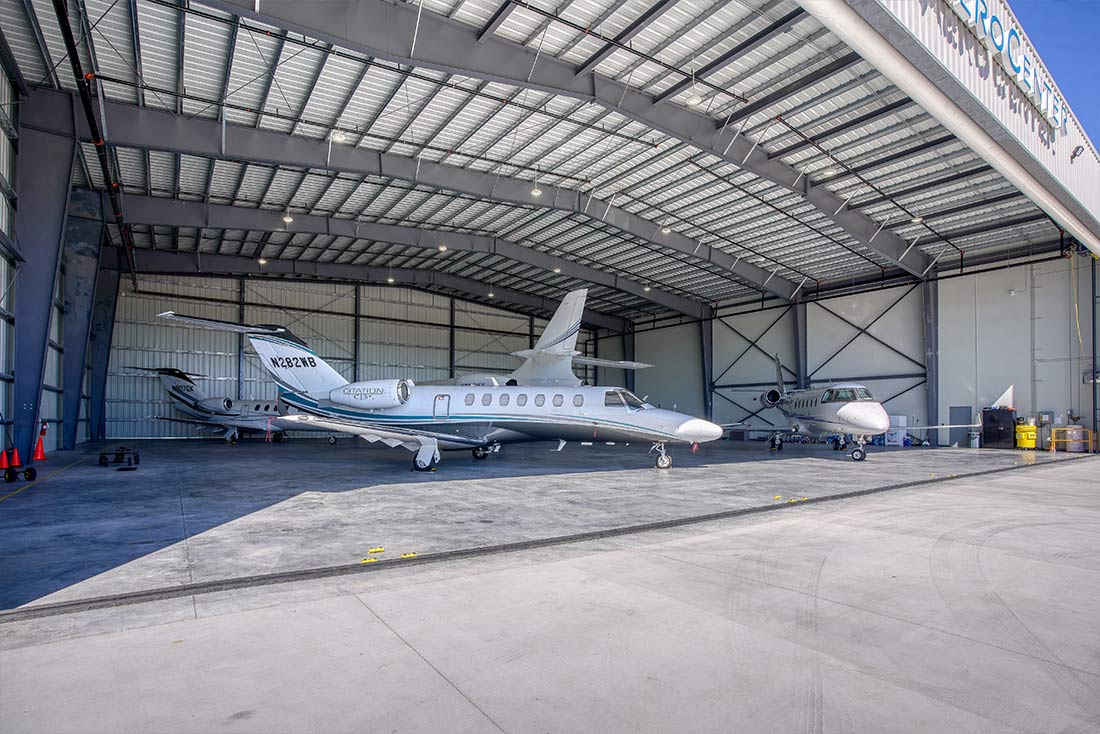
Start with a real budget. Materials, site work, equipment, and the land itself all have to be accounted for. Most hangars are built in steel because it delivers the clear span widths aircraft storage requires at a cost wood and concrete can’t match at that width, and because it goes up faster while you’re still paying to store the aircraft somewhere else.
Site Factors That Affect Budget
- Soil conditions and what the foundation will require
- Lot size and how it limits or expands your design options
- Whether you’re building on private land or leasing at a public airport
- Local material and labor costs in your region
Get clarity on these before you commit to a design. The cost to adjust a number on paper is nothing. The cost to adjust it after the steel is manufactured is real.
What Actually Drives Hangar Cost?
Size is the obvious variable. The rest are where people get caught, and it’s why any per square foot number quoted before someone asks about your aircraft, your door, and your site is a guess.
The door system
Aircraft dimensions set the opening, and the opening sets the framing and header around it. On many hangars the door is the largest single line item after the structure itself. The options and their tradeoffs are covered in Choosing the Hangar Door below.
Clear span
Width without interior columns costs more per square foot than the same footprint with columns in it. On a hangar, interior columns usually aren’t an option, so the span is a cost you’re absorbing by definition, not a choice.
Site conditions
Soil, drainage, and what the foundation has to carry once the aircraft and equipment are inside.
Load requirements
Wind, snow, and seismic are engineered to your location. A hangar built for a Florida coastal county is a different building than the same footprint in the upper Midwest.
Land position
Private property behaves differently than a leasehold on public airport land, both in cost and in what you’re permitted to build.
Regional rates
Regional material and labor rates.
What It Costs to Own
The steel quote is only part of the cost. A shorter schedule cuts spending on everything around the structure, including builder’s risk insurance, site security, equipment rental, and the general conditions a GC carries for every week the job stays open.
Then there’s what the building costs once it’s standing. Coatings, insulation, and roof panel selection drive the utility bill for decades. Steel won’t rot or attract pests, so upkeep is mostly checking fasteners, seals, and roof panels. Expansion is cheaper too, when the original frame was engineered to take the added bays.
Build, Buy, or Lease?
Most owners work through the same three options. The right one depends on how specific your requirements are and how long you plan to stay.
Build, buy, or lease at a glance
| Option | What you get | Works well when | Watch out for |
|---|---|---|---|
| Lease | A spot, not a building | You want the fastest path and the smallest commitment | Configuration, access hours, and who’s parked next to you are someone else’s decision |
| Buy existing | A structure somebody else spec’d | The door clears your aircraft and the footprint suits how you operate | Modifying an existing hangar is expensive and sometimes not possible at all |
| Build | Control of the door, the span, the layout, and the location | Your requirements are specific and you plan to stay | The highest upfront cost and the longest timeline |
Leasing space in a shared facility is the fastest path and the smallest commitment. You get a spot, not a building. Configuration, access hours, and who’s parked next to you are all someone else’s decision.
Buying an existing hangar puts you in a structure somebody else spec’d. That works when the door clears your aircraft and the footprint suits how you operate. It works poorly when either one is close but not right, because modifying an existing hangar is expensive and sometimes not possible at all.
Building gives you control of the door, the span, the layout, and the location. It carries the highest upfront cost and the longest timeline.
We build. If a lease or an existing facility is the better answer for what you’re flying, we’ll tell you that early rather than sell you a building you didn’t need.
Choosing the Site
Where the hangar goes affects the budget as much as what goes inside it. A site that’s difficult to reach adds cost to every delivery and every crew day. A site in a hurricane corridor or heavy snow region adds cost to the structure itself.
Distance from the ramp is its own calculation. Far out and you’re driving to your aircraft every time you fly. Close in and you may be competing for staging and parking room on ground the airport controls tightly, so the authority is worth a call before you settle on a spot.
Parcel size sets your options for orientation, apron layout, and expansion. A tight lot narrows the footprint before anything has been drawn.
Confirm all of the following before you commit to a site:
- The ground is level enough, and large enough, for the footprint you actually need
- Water, sewer, and fire hydrant access reach the location
- Trucks carrying steel and door components can reach the site and turn around
- The parcel sits outside a flood zone or other known hazard area
- Local zoning permits a hangar on that parcel
- Neighboring parcels are zoned for compatible use, whether commercial, residential, or agricultural
- The airport authority approves a structure in that position, if you’re building on airport land
What Regulations Apply to an Airplane Hangar?
Where you build determines what you’re allowed to build. If the hangar is going on private land with your own strip, you’ll need zoning approval and permits from local authorities, plus verification of the legal distance required between your runway and nearby airports.
If it’s going on airport property, the airport authority carries its own requirements on top of the municipality’s. Start both conversations early.
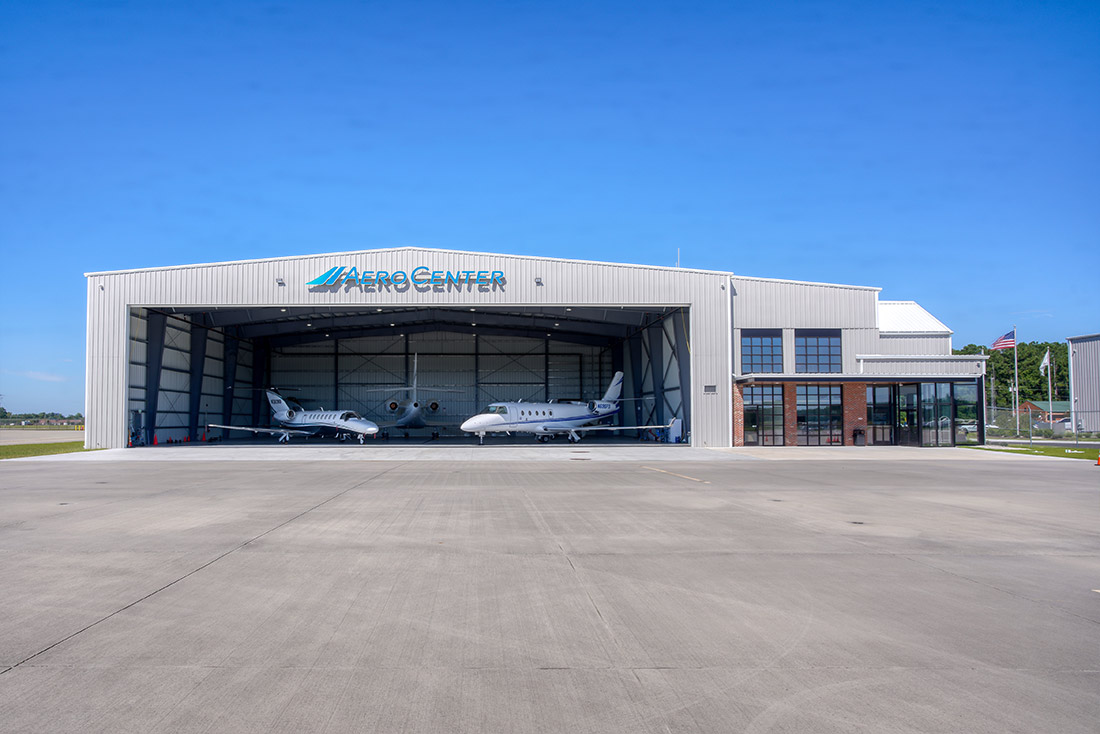
Check for Restrictions in Advance
Your local building department sets codes and zoning requirements that can change the design, sometimes significantly.
Confirm the following before drawings are finalized:
- Fire suppression requirements for the hangar classification you fall under
- Lot coverage limits, meaning how much of the parcel the structure is permitted to occupy
- Stormwater handling and drainage requirements
- Approved cladding types in your jurisdiction
- Whether a sealed floor is required
- Required access points, including egress and any fire department access
Fire suppression is worth its own conversation early. Hangar fire protection is typically governed by NFPA 409, the national standard for aircraft hangars, which sorts hangars into groups based largely on door height, fire area, and construction type. That classification sets what suppression the building needs.
NFPA 409 Hangar Groups at a Glance
| Group | Aircraft door height | Fire area | Notes |
|---|---|---|---|
| Group I | Over 28 ft, or the hangar houses aircraft with a tail height over 28 ft | Over 40,000 sq ft | Any one of these features puts a hangar in Group I. The most demanding fire protection requirements. |
| Group II | 28 ft or less | Up to 40,000 sq ft | Both features required. The fire area limit depends on construction type. |
| Group III | 28 ft or less | Smaller fire areas | Row, open-bay, or freestanding hangars. The fire area limit depends on construction type. |
| Group IV | Classified by construction type | Classified by construction type | Membrane-covered structures on a rigid steel frame. The least strict requirements. |
Simplified summary of NFPA 409, Standard on Aircraft Hangars (2022 edition). Exact fire area limits depend on construction type, and the 2022 edition added alternatives to foam suppression in some cases. Your fire protection engineer and local authority having jurisdiction set the final classification.
Larger hangars often call for foam systems, such as a low-level, low-expansion foam system paired with foam and water hand-hose stations. Those systems carry structural implications that are difficult to retrofit into a finished building. On Olympus Air the suppression system was engineered into the structure from the outset for exactly that reason.
Plan for What Else the Building Has to Do
Very few hangars only store aircraft. Before the layout is set, work out everything else that has to happen inside the building.
Aircraft count is the first question, and type is the second. Piston singles, jets, helicopters, gliders, and ultralights each bring different clearance, door, and floor needs, and a mixed fleet has to work for all of them. Ground support equipment, tugs, and tooling take up floor area that’s easy to overlook until it’s gone. Decide early, too, whether you intend to lease space to other owners.
Then the occupied space. Offices, a shop, restrooms, a crew or passenger area. Each carries its own utility and code requirements, and climate control belongs in the same conversation in regions where humidity or cold affects how aircraft are stored.
Olympus Air, Hazleton Regional Airport
- Type
- FBO hangar
- Dimensions
- 160 x 100 ft, 36 ft eave
- Size
- 20,000 sq ft
- Fire protection
- Integrated foam suppression
Olympus Air at Hazleton Regional Airport is a 20,000 square foot FBO hangar housing private aircraft owners and a jet charter operation under one roof. Fire code compliance, airport authority requirements, and an integrated foam fire suppression system were engineered into the structure from the outset rather than layered on afterward.
Maintenance Hangars and Lifting Loads
If maintenance happens inside the hangar, plan for what gets lifted. Pulling an engine or a heavy component usually means a gantry or an overhead crane, and the frame has to be engineered to carry that load. Adding crane capacity to a finished building is expensive when it’s possible at all.
Bracing placement matters just as much, since it has to stay clear of door openings and the paths aircraft and equipment move through.
Door sizing and access points come out of all of it.
Sizing the Hangar
Hangar size starts with the aircraft and the clearances around it. Wingspan and tail height set the door opening. How the aircraft gets moved in and out sets how much width you need beyond the wingtips.
For scale: a single piston aircraft can work in a footprint under 3,000 square feet. Corporate and multi-aircraft facilities commonly run 10,000 to 50,000 square feet. Large commercial and MRO operations go well past that.
Example Aircraft Dimensions
Wingspan and height are where door sizing starts. Here’s how common aircraft compare:
| Aircraft class | Example aircraft | Wingspan | Length | Height |
|---|---|---|---|---|
| Single-engine piston | Cessna Skyhawk (172) | 36 ft 1 in | 27 ft 2 in | 8 ft 11 in |
| Twin-engine piston | Beechcraft Baron G58 | 37 ft 10 in | 29 ft 10 in | 9 ft 9 in |
| Single-engine turboprop | Pilatus PC-12 NGX | 53 ft 6 in | 47 ft 3 in | 14 ft |
| Light jet | Embraer Phenom 300E | 52 ft 2 in | 51 ft 4 in | 16 ft 9 in |
| Super-midsize jet | Bombardier Challenger 3500 | 69 ft | 68 ft 8 in | 20 ft |
| Large-cabin jet | Gulfstream G700 | 103 ft | 109 ft 10 in | 25 ft 5 in |
Manufacturer-published exterior dimensions. Door opening, clearances, and footprint are engineered around your specific aircraft and how it’s moved in and out.
For a working reference point, Olympus Air is 160 by 100 with a 36 foot eave, 20,000 square feet, built as an FBO at Hazleton Regional Airport.
We spec each hangar around the aircraft going into it and the operation around it, then design in the structural capacity for the bays you’re likely to add later. More on how we approach private, corporate, FBO, and MRO facilities is on our aviation page.
Choosing the Hangar Door
Wingspan and tail height set the size of the opening. The door type decides how that opening operates and what the frame around it has to carry. Your door supplier provides a spec sheet, and we engineer the framing and header around it.
Hangar Door Types Compared
The right door depends on the size of the opening, the wall and clearance you have to work with, and the budget. Here is how the four common options compare.
| Door type | How it opens | Space it needs | Relative cost | Typical fit |
|---|---|---|---|---|
| Sliding | Panels roll on top and bottom tracks and stack to one or both sides of the opening | Wall length beside the opening for the panels to stack | Highest, and often the only practical option on the largest openings | Large openings, plus box and multi-unit hangars with side wall to spare |
| Bi-fold | Door splits horizontally and folds upward, acting as an awning when fully raised | Very little side wall, with some clearance in front as it folds | Lower than sliding | Private and corporate hangars where wall space is limited |
| Hydraulic | One solid panel lifts outward and up on hydraulic cylinders, forming a canopy | A clear zone in front of the door while it opens | Lower than sliding | Private and corporate hangars with clearance in front of the door |
| Fabric | Reinforced fabric panel lifts vertically and gathers at the header | Headroom above the opening | Premium, varies with opening width and drive system | Very wide openings on commercial and MRO facilities |
Door selection affects header loads and framing, so it is settled before the steel is manufactured.
The door is also a structural load. Bi-fold and hydraulic doors put significant weight on the header and columns, so the frame is designed around the specific door before the steel is manufactured. Order the door early, because door lead time often runs longer than steel lead time.
Most hangars also need smaller openings. Overhead sectional doors work well for shop areas and equipment access, and personnel doors handle daily entry and required egress.
Floors and Foundation
A hangar slab carries more than a parked aircraft. Tugs, jacks, tool carts, and lifting equipment all put point loads on the floor, and the foundation also anchors a frame engineered for your site’s wind and seismic loads. Reinforced concrete is the standard, designed around your soil and what will operate on the slab.
Fuel, oil, and hydraulic fluid will end up on the floor, so the coating has to hold up to all three plus moisture and staining. Skid resistance gives crews and tugs grip. Static dissipation matters where fueling happens indoors. Some jurisdictions require a sealed floor outright.
How Long Does a Hangar Take to Build?
Schedule depends on size, door lead time, and permitting more than anything else. A private single aircraft hangar can go up in weeks once materials are on site. A commercial or FBO facility runs months, and most of that time is spent before the first bolt.
The sequence
- Design and spec. Aircraft dimensions, door system, clear span, floor loads, and any office, shop, or restroom space going inside the building.
- Permits and approvals. Municipal building department, zoning, and the airport authority where applicable. This is the step that most often sets the schedule.
- Engineering and manufacturing. The building is engineered to your site’s specific loads and fabricated off site. Door lead time frequently runs longer than steel lead time, which is why the door gets ordered early.
- Foundation. Poured to carry the structure and whatever operates on the slab.
- Erection. Primary frame, secondary framing, roof and wall panels, then the door system.
- Finishing. Insulation, cladding details, electrical, and interior build out.
Every step depends on the one ahead of it. Permitting and door lead time move schedules the most, and door lead time is the one people underestimate. On Olympus Air, a strike at the door supplier’s plant pushed delivery well past plan. The section for general contractors below covers how that was handled.
Insulation and Cladding
Insulation controls temperature swings and condensation, and condensation inside a hangar lands on the aircraft. The right system depends on your climate, how the building is used, and whether the space is conditioned.
Cladding has to meet whatever your jurisdiction approves, which is worth confirming during design rather than after.
Power and Ventilation
Hangar MEP is not warehouse MEP. Fuel vapor, aircraft-scale lighting, and maintenance tool loads all change the spec, and the runs get coordinated against the frame during design.
Ventilation. Engine exhaust and fuel fumes have to go somewhere, and the answer is usually a combination of ceiling height, ridge vents, and fans sized to the volume. Powered skylights work in some buildings. In humid climates ventilation and insulation work together, because condensation that forms in the building lands on the aircraft.
Building a Hangar as a GC or Architect
Hangar projects rarely have the owner running them. A general contractor is usually carrying the schedule, and an architect is usually carrying a design that has to survive contact with PEMB engineering parameters.
For general contractors
For GCs, hangars concentrate the risk in two places: door lead time and permitting. Both sit outside your control and both can move a hard open date. We pull multiple quotes through our manufacturing network so you have pricing options before the bid locks in, and we stay in the coordination through delivery and erection.
On Olympus Air, the door supplier’s Michigan plant went out on strike mid-project. Door delivery slipped, and a delay like that rolls through every step of installation behind it. We put our own field supervisor on door sheeting when the doors arrived, absorbed the cost, and kept the change order conversation off the table. That is the version of this that a GC should expect from a steel partner.
For architects
For architects, the constraint is that PEMB systems work within defined engineering parameters, and a hangar design that doesn’t account for them gets revised after the fact. Bring us in during concept and we will validate the spec against real manufacturing parameters before the design is committed.
Frequently Asked Questions
What is an airplane hangar?
An enclosed building for storing and maintaining aircraft, usually built in steel because steel delivers wide column-free spans at a practical cost. Types range from T-hangars for single small aircraft to full FBO and MRO facilities.
How much does it cost to build an airplane hangar?
There’s no reliable per square foot number, and most figures published online cover materials only. Cost depends on the door system, clear span, site conditions, load requirements, and whether you’re building on private land or an airport leasehold.
What size hangar do I need?
Start with wingspan, tail height, and the room needed to move the aircraft in and out. A single piston aircraft can fit in under 3,000 square feet, while corporate and multi-aircraft facilities commonly run 10,000 to 50,000 square feet.
What type of hangar door is best?
It depends on the size of the opening, the wall space you have, and the budget. Sliding doors aren’t the most economical option, but on large openings they’re often the one that makes sense. Bi-fold and hydraulic doors save side wall space but put more load on the header.
What kind of floor does an airplane hangar need?
Reinforced concrete with a coating that holds up to fuel, oil, and hydraulic fluid. It also needs grip for tugs and crews, and static dissipation where fueling happens indoors. Some jurisdictions require a sealed floor.
How long does it take to build an airplane hangar?
A private single aircraft hangar can go up in weeks once materials are on site. Commercial and FBO facilities take months, and permitting and door lead time set most of that schedule.
Is it better to build or lease a hangar?
Leasing is faster and costs less upfront. Building takes longer and costs more, but you control the door, the span, the layout, and the location. If a lease fits what you fly, we’ll tell you that early.
Ready to Talk Through Your Hangar?
Early planning, an active bid, or a hard open date that can’t move. Tell us where you are and we’ll take it from there.
We exhibit at NBAA-BACE every year. If you’re headed to Las Vegas October 20 to 22, find us on the show floor and we’ll talk through your project in person.